Golf Simulator Room Size: How Much Space Do You Really Need?
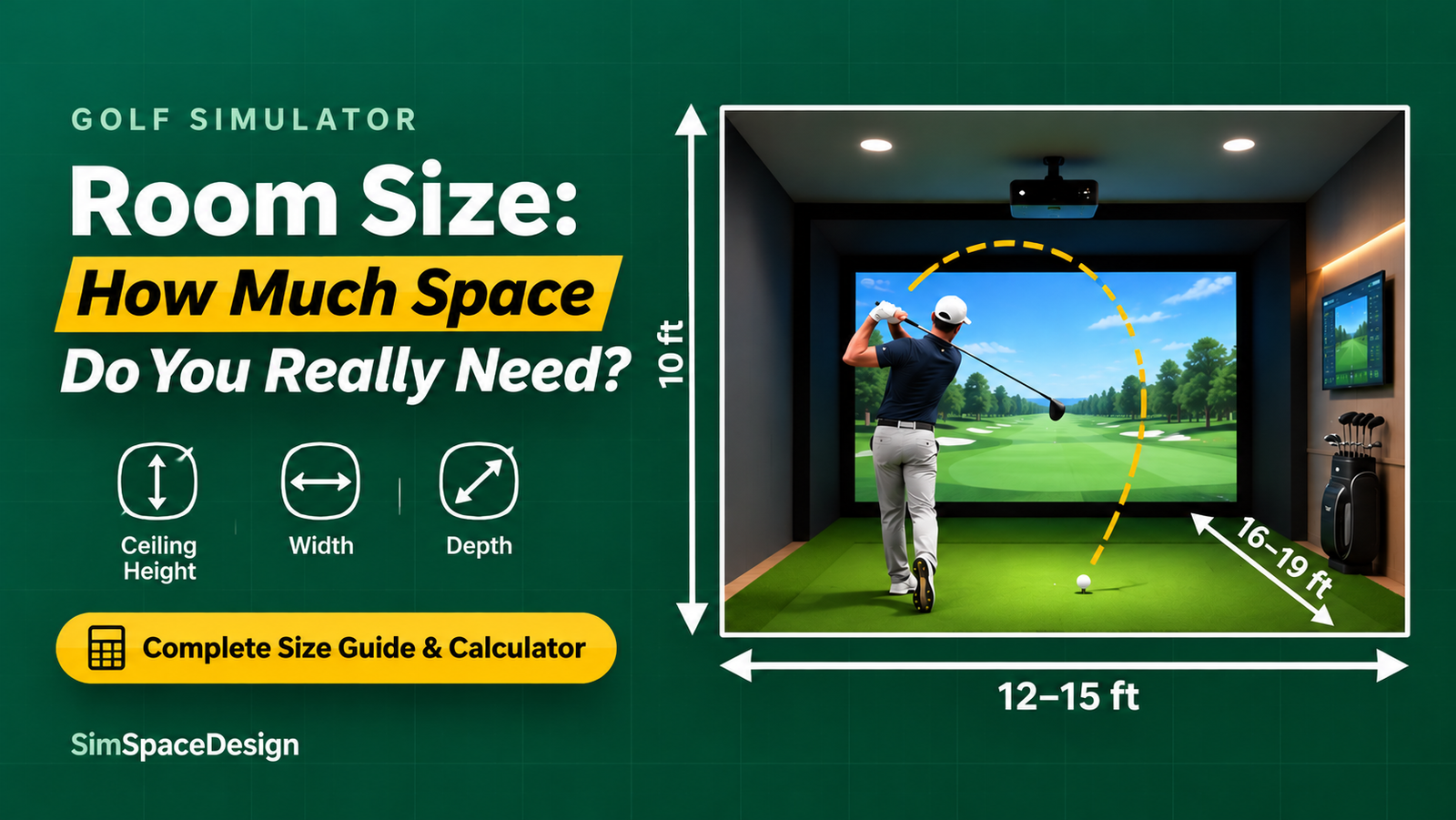
Quick answer: The minimum golf simulator room size is about 9 feet high, 10 feet wide, and 13 feet deep. If you want a full driver swing that doesn’t feel cramped, aim for 10 feet high, 12 to 15 feet wide, and 16 to 19 feet deep. Of the three, ceiling height matters most, because it’s the one you usually can’t change.
Space Needed at a Glance
| Dimension | Minimum | Comfortable |
|---|---|---|
| Ceiling height | 9 ft | 10 ft+ |
| Width | 10 ft | 12–15 ft |
| Depth | 13 ft | 16–19 ft |
Want numbers for your exact space? Try my free golf simulator room size calculator.
Here’s the thing nobody tells you when you start looking at simulators: the gear is the easy part. You can find a launch monitor for almost any budget. What you can’t buy is an extra foot of ceiling.
So before anyone spends thousands on a screen and enclosure, I think the first question should always be: will a full swing actually fit here? That’s what this guide answers. I’ll walk through every part of golf simulator room size, why each number matters, and how to measure your own space without fooling yourself.
A quick note on where these numbers come from: I’m a data analyst, not a golf pro, and I haven’t built every one of these setups myself. What I did was go through published room guidelines from launch monitor makers and simulator retailers, line them up side by side, and look for where they agree. Where they don’t, I’ve said so. Always double-check against your own equipment’s specs.
The Three Dimensions That Decide Golf Simulator Room Size
When you strip away the marketing, golf simulator space requirements come down to three measurements. Here they are in the order I’d worry about them:
- Ceiling height decides whether you can swing a driver at all.
- Depth decides whether your launch monitor reads the ball properly and how much the ball bounces back at you.
- Width decides how relaxed your swing feels, and whether a left-handed friend can play too.
Come up short on depth or width, and you can often work around it with the right equipment. Come up short on ceiling height, and your options shrink fast.
Ceiling Height: The Number I’d Check First
At the top of a driver swing, the clubhead rises roughly 3 to 4 feet above your head. So the right ceiling height isn’t really about the room. It’s about the tallest person who’ll ever swing in it. Rapsodo’s ceiling height guide puts the general minimum at around 9 feet, and every source I checked agreed that taller golfers need more.
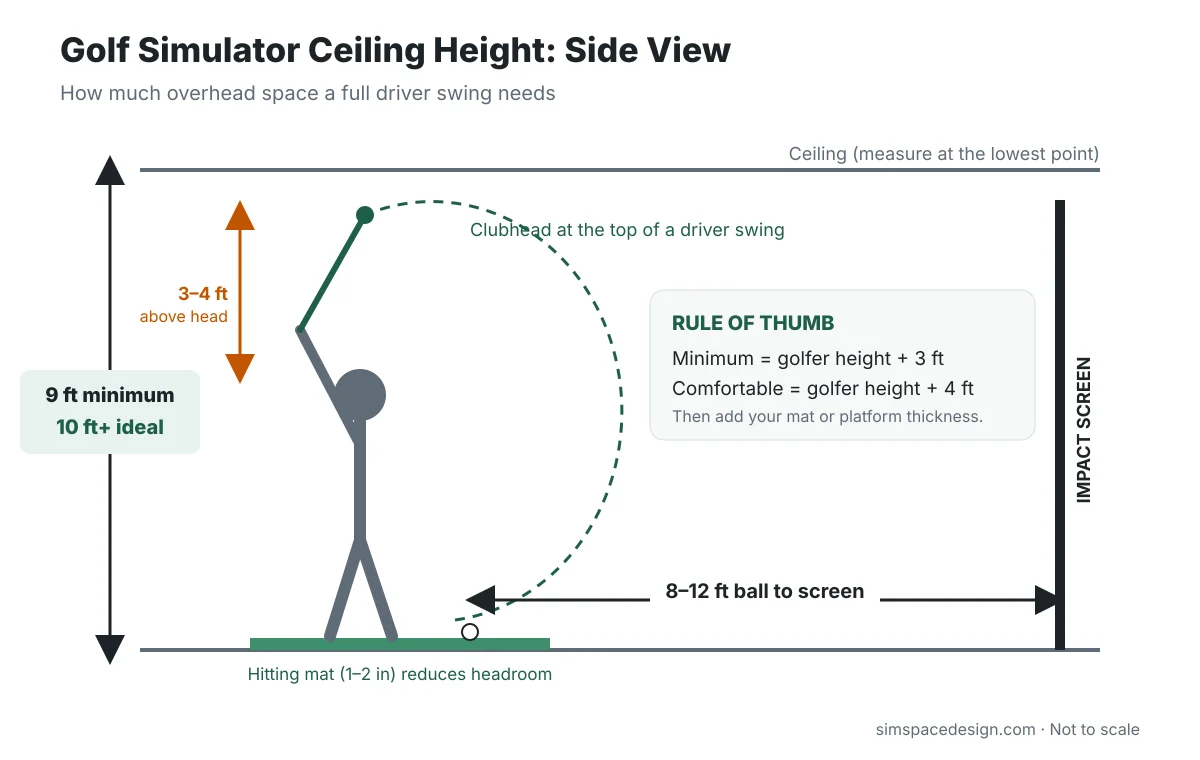
Here’s the simple rule I use: golfer height plus 3 feet for the minimum, plus 4 feet for comfort.
| Golfer height | Minimum ceiling | Comfortable ceiling |
|---|---|---|
| 5 ft 6 in | 8 ft 6 in | 9 ft 6 in |
| 5 ft 10 in | 8 ft 10 in | 9 ft 10 in |
| 6 ft 0 in | 9 ft 0 in | 10 ft 0 in |
| 6 ft 3 in | 9 ft 3 in | 10 ft 3 in |
| 6 ft 6 in | 9 ft 6 in | 10 ft 6 in |
What surprised me most while researching this is how many small things quietly steal ceiling height:
- Hitting mats and platforms. A standard mat adds 1 to 2 inches. A raised platform can add 6 inches or more.
- Ducts, beams, and light fixtures. Measure from the lowest point above your swing, not the open ceiling.
- Ceiling-mounted projectors. Put them in front of the hitting area, never directly above it.
- Garage door tracks and openers. These often hang lower than the ceiling itself.
Only have 8 feet? I’ll be honest: a full driver swing probably won’t happen. Shorter golfers might manage irons and wedges, but if your golf simulator room size is capped by an 8 ft ceiling, a putting and chipping setup is usually the smarter buy.
Room Depth: Where Your Launch Monitor Matters
Depth is the distance from the wall behind your impact screen to the back wall. It’s easiest to think of it as three pieces:
- Gap behind the screen: about 1 foot, so the screen can absorb a shot without slapping the wall.
- Ball to screen: 8 to 12 feet. Any closer than 8 feet and you get more bounceback, and some launch monitors struggle to read the shot.
- Behind the ball: room for your backswing, plus your launch monitor if it sits behind you.
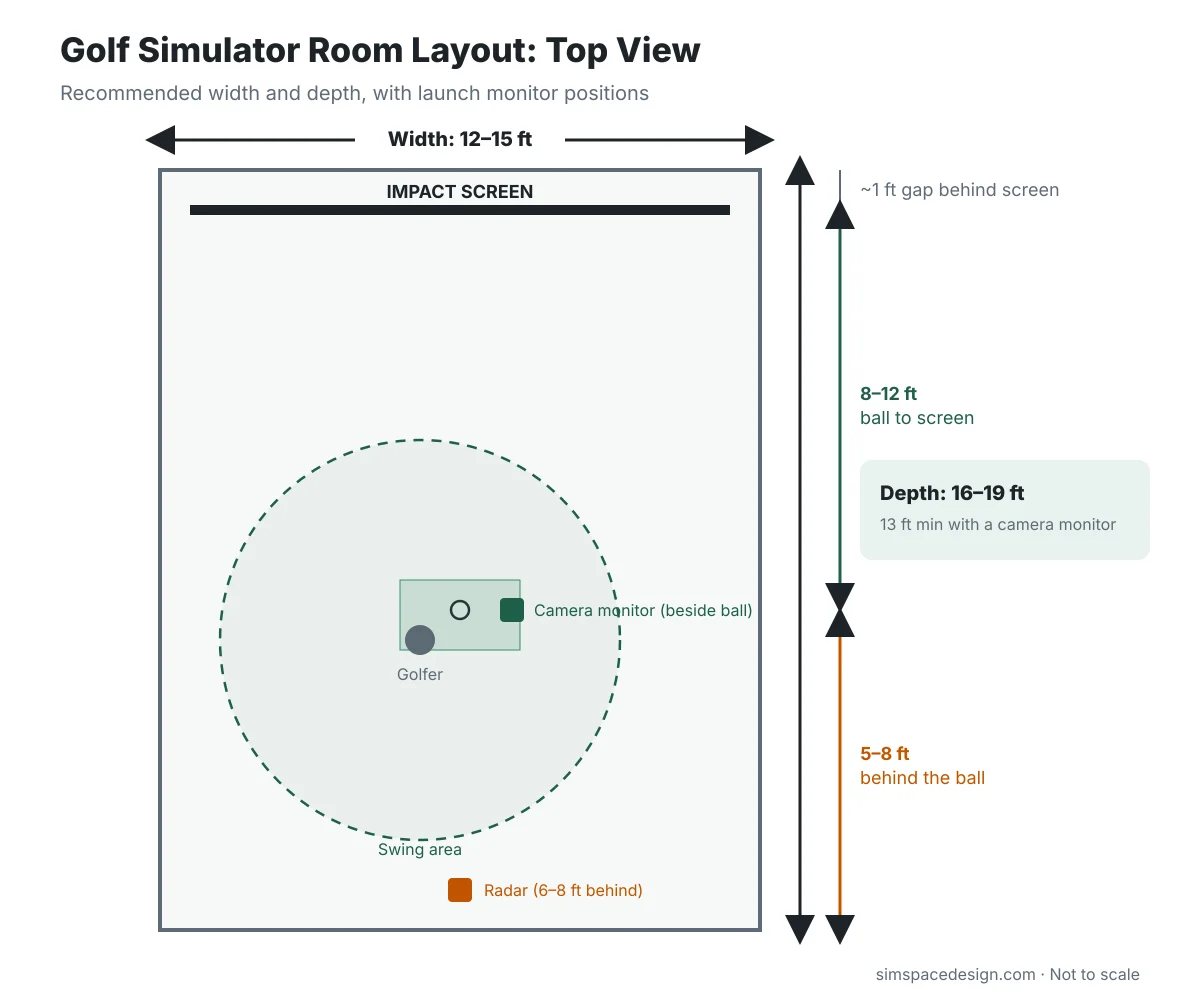
That last piece is where your choice of launch monitor changes the golf simulator room size you need:
| Launch monitor type | Where it sits | Minimum depth | Comfortable depth |
|---|---|---|---|
| Camera-based (photometric) | Beside the ball | 13 ft | 16 ft |
| Overhead / ceiling-mounted | Above the hitting area | 13 ft | 16 ft |
| Radar (Doppler) | 6–8 ft behind the ball | 16 ft | 19 ft |
Radar units track the ball in flight, so they need to sit well behind you and need room in front to measure the shot. PlayBetter’s Garmin R10 space requirements guide shows just how much extra depth that adds. My take: if your room is under 16 feet deep, a camera-based monitor that sits beside the ball is the safer bet.
Room Width: Comfort and Safety
Width is the part of golf simulator room size that people tend to underestimate. It affects how free your swing feels, how big a screen you can fit, and who can play.
| Who will play | Minimum width | Comfortable width |
|---|---|---|
| Right-handed only (or left-handed only) | 10 ft | 12 ft |
| Both right- and left-handed | 13 ft | 15 ft |
If only one type of golfer will play, you can shift the hitting spot a little off-center so the swing sits closer to the middle of the room. If you have lefties and righties in the house, the tee has to be centered, and that takes more width.
Width also caps your screen size, so it’s worth getting these golf simulator dimensions right before you order an enclosure. Leave at least 6 inches on each side of the screen for the enclosure frame and side netting.
Golf Simulator Room Size by Type of Space
Most people are working with one of these rooms. Here’s how they usually stack up on golf simulator dimensions:
| Room | Typical fit | What usually goes wrong |
|---|---|---|
| Two-car garage | Usually great: wide and deep | Ceiling height and garage door tracks |
| One-car garage | Often works for one-handed golfers | Width, even with the car moved out |
| Basement | Good depth and width | Low ceilings, ducts, and support posts |
| Spare bedroom | Tight | Depth, and 8 ft ceilings |
| Bonus room or barn | Excellent | Usually nothing |
How to Measure Your Golf Simulator Room Size (Step by Step)
Grab a tape measure and a driver. This takes about ten minutes.
- Pick the screen wall. Choose the longest clear direction in the room.
- Measure depth from that wall to the opposite wall, along the floor.
- Measure width where you’ll actually stand to hit, not at the doorway.
- Measure ceiling height at the lowest point above your swing, including anything hanging down.
- Take a test swing. Stand where the ball will sit and make a slow, full swing with your driver. If you flinch, the room is too tight.
- Run your numbers through my room size calculator to see where your ball and screen should go.
If you’d like a second opinion, Carl’s Place has a solid walkthrough on measuring your space for an indoor golf simulator.
Common Golf Simulator Room Size Mistakes
These came up again and again in owner discussions I read. Each one is easy to avoid if you know about it upfront:
- Measuring the open ceiling instead of the lowest obstruction. One duct can turn a 9 ft room into an 8 ft room.
- Forgetting the hitting mat. Every inch you stand on is an inch less overhead.
- Buying a radar launch monitor for a short room. Check how far behind the ball it needs to sit before you order.
- Putting the ball too close to the screen. Under 8 feet means more bounceback and less reliable data.
- Planning only for yourself. Size the room for the tallest person who’ll ever pick up a club in it.
Frequently Asked Questions
What is the minimum golf simulator room size?
Most setups need at least 9 feet of ceiling height, 10 feet of width, and 13 feet of depth. Radar launch monitors that sit behind the ball need closer to 16 feet of depth.
What is the ideal golf simulator room size?
For most homes, I’d target 10 feet high, 15 feet wide, and 18 to 19 feet deep. That fits a full driver swing, either type of launch monitor, and golfers of either hand.
Can I put a golf simulator in a room with 8 ft ceilings?
Usually not for full driver swings. Shorter golfers may be able to hit irons and wedges, but most people with 8 ft ceilings are better off with a putting and short-game setup.
Is 10 feet of ceiling height enough?
Yes, for most golfers up to about 6 feet tall. Taller golfers, or anyone with a steep swing, may want 10.5 to 11 feet.
How far should the ball be from the impact screen?
Aim for 8 to 12 feet. Closer than 8 feet increases bounceback and can affect launch monitor accuracy.
How wide should a golf simulator room be for left- and right-handed golfers?
Plan for at least 13 feet, and ideally 15, so the tee can sit in the center and both golfers have safe clearance.
Check Your Golf Simulator Room Size Now
Every room has its quirks, and general rules only go so far. Plug your exact measurements into my free golf simulator room size calculator to see how your space rates, where to place the ball, and the biggest screen you can fit. And if your room is unusual, send me the measurements. I’m happy to take a look.